
Umbraco at Battle Choose Your Fighter: Umbraco vs Sitecore
The open-source challenger takes on the enterprise giant
Website decisions used to be simple: if you needed serious digital infrastructure, you bought a serious platform. Sitecore was perceived as the gold standard: feature-rich, deeply integrated, and trusted by some of the world's largest organisations. But the ground has shifted. Budgets are tighter, marketing teams want more autonomy, and a new generation of composable platforms is asking an uncomfortable question: what if you've been paying for a lot of things you don't actually need?
This is the first in our Choose Your Fighter series, a no-spin evaluation of Umbraco against its nearest competitors, across the variables that actually matter to communications and marketing leaders. We're not here to sell you a platform. We're here to give you the comparison your vendor won't.
Round 01: Licensing & Total Cost of Ownership
The number your CFO will ask about
| Umbraco | Sitecore |
| Umbraco is open-source at its core, meaning the platform itself carries no mandatory licence fee. Commercial hosting via Umbraco Cloud starts from a few hundred pounds per month, and organisations migrating from legacy enterprise platforms regularly report total ongoing costs dropping to around £350/month, inclusive of hosting. Optional paid add-ons exist, but you choose what you need. | Based on market intelligence, annual licence fees typically range from £50,000 to £80,000 before a single line of development is written. Add implementation, XM Cloud infrastructure, and ongoing support contracts, and the true TCO can quickly enter six figures per year. To put that in context: smaller deployments with basic CMS needs commonly land between £60,000–£200,000 in year one once implementation is included; mid-market organisations running personalisation, multiple modules, and higher traffic typically budget £200,000–£600,000+; and large enterprise multi-site builds with full DXP capabilities can comfortably exceed £800,000 annually. Figures are negotiated under NDA, so your mileage and leverage may vary. |
Verdict
Umbraco wins clearly. For most mid-market organisations, the TCO difference is not marginal, it's transformational. The question isn't whether Umbraco is cheaper; it's whether Sitecore's additional capabilities justify a cost differential that can fund an entire marketing headcount.
Round 02: Platform Architecture & Flexibility
What you're actually buying
|
Umbraco |
Sitecore |
|
Umbraco is a composable Digital Experience Platform (DXP): an intentionally lean core that you build out with only the capabilities your organisation actually uses. Headless-ready, cloud-native, and built on modern .NET foundations, it gives development teams genuine architectural freedom without forcing you to maintain a sprawling suite of tools you don't touch. Marketing teams get a clean, intuitive back-office; developers get an un-opinionated platform. |
Sitecore is a monolithic Digital Experience Platform (DXP): everything is included by default, whether you need it or not. That comprehensiveness can be genuinely powerful for large enterprises with complex multi-channel requirements. But for most organisations, it means buying and maintaining a platform that is significantly more complex than their use case demands. The interface reflects that complexity, with steep learning curves reported by non-technical content editors. |
Verdict
Depends on your context. If you're a large enterprise with genuine omnichannel complexity, Sitecore's breadth has value. If you're a mid-market organisation that wants modern architecture without the overhead, Umbraco's composable approach is a more honest fit, and significantly easier and still extremely capable to evolve.
Round 03: Content Editor Experience
The platform your team actually lives in
| Umbraco | Sitecore |
| Umbraco's back-office is designed with non-technical editors in mind. The interface is clean, onboarding time is low, and content teams typically reach independence quickly. Reducing the volume of developer involvement in day-to-day content operations. For organisations where marketing owns the website, this translates directly into faster campaign execution and lower agency dependency. | Sitecore's interface is powerful, but complexity is the trade-off. Organisations commonly report that content editors require substantial training, and that day-to-day tasks involve a steeper cognitive load than comparable platforms. When staff turn over (which in marketing functions, they often do) that training overhead recurs. Sitecore itself acknowledges this through premium-tier support and certification programmes. |
Verdict
Umbraco wins on usability. G2 peer review data scores Umbraco at 8.8 for ease of use against Sitecore's 7.1. For comms teams managing high content volumes across multiple stakeholders, that gap compounds over time into real operational cost.
Round 04: Features & Marketing Capabilities
What's in the box, and what you actually need
| Umbraco | Sitecore |
| Out of the box, Umbraco is deliberately lean, but that's the point. Personalisation, A/B testing, marketing automation, and analytics integrations are all achievable via a natively-built add-on ecosystem. Because add-ons are purpose-built for Umbraco rather than bolted on via acquisition, integration is deep and performance is consistent. You pay for what you use, and nothing else. | Sitecore's feature set is genuinely comprehensive. A/B testing, personalisation, Customer Data Platform (CDP), and integrated marketing tools are available within the suite. However, much of this capability has been assembled through acquisition rather than organic development, and critics note that the "Connect" integrations required to stitch tools together can add cost and complexity. You pay for the full suite whether you use it or not. |
Verdict
Sitecore leads on raw feature depth, but it’s worth noting that most organisations use a fraction of what they pay for. Umbraco's composable approach means you can match Sitecore's relevant capability set at a fraction of the cost, without inheriting its unused complexity.
Round 05 (the final round): Vendor Lock-in & Long-term Risk
What happens if you want to leave
| Umbraco | Sitecore |
| As an open-source platform, Umbraco has no structural lock-in. Your codebase, your content, and your data are yours. Hosting is flexible, makes use of Umbraco Cloud, self-hosted, or any cloud provider. The development community is large, well-documented, and global, meaning you're not dependent on a single certified partner ecosystem to maintain or evolve your platform. | Sitecore is private-equity backed, and enterprise software under PE ownership has a well-documented pattern: price increases, product rationalisation, and support tier changes over time. Sitecore's partner certification requirements and premium support structures create real switching costs such as commercial, technical, and operational. Organisations on Sitecore XP navigating the transition to XM Cloud are experiencing this dynamic directly right now. |
Verdict
Umbraco wins on independence. Open-source architecture with no forced migration path and no PE-driven pricing pressure is a meaningful long-term risk advantage, particularly for organisations in the middle of multi-year digital strategies.
The Peer Review Scorecard
A comparison from real users. Independent ratings.
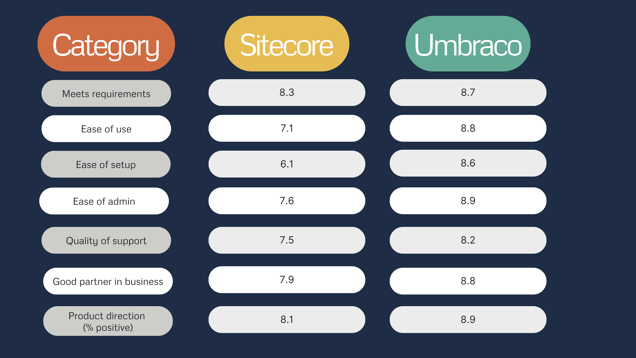
And the winner is… Umbraco
For mid-market organisations that want enterprise-grade capability without enterprise-grade licensing bills, Umbraco consistently outperforms Sitecore on cost, usability, flexibility, and independence. Sitecore remains a credible choice for the largest organisations with genuinely complex omnichannel needs, but that's a narrower category than its legacy status might suggest. If you're currently on Sitecore and questioning whether the relationship still makes commercial sense, you're not alone.