
Umbraco at Battle Choose Your Fighter: Umbraco vs Kentico
The open-source contender meets the all-in-one mid-market platform
If the Sitecore comparison was Canva handing a marketing manager the keys to design without a six-week training course or a £600-a-year Creative Cloud subscription, the Umbraco vs Kentico fight is more nuanced. These two platforms compete in similar territory: mid-market organisations, multi-site deployments, and teams that want serious capability without enterprise-level complexity. On paper, Kentico Xperience looks compelling: a unified workspace combining CMS and marketing tools in a single dashboard. But the closer you look, the more the cracks appear.
This is the second installment in our ‘Choose Your Fighter’ series. Same format, same rigour. We examine both platforms honestly across the variables that matter most to communications and marketing leaders making real procurement decisions.
Round 01: Licensing & Total Cost of Ownership
What you’re committing to financially
| Umbraco | Kentico |
| Umbraco publishes its pricing openly, a deliberate ethical choice for a commercial open-source company. The core platform is free. Umbraco Cloud hosting is clearly tiered and publicly listed. Add-ons like Umbraco Commerce and Engage carry transparent per-feature pricing. There are no surprise per-channel fees, no headless surcharges, and no negotiated deals that shift depending on your negotiating position. | Kentico's licensing model escalates with usage in ways that aren't always obvious at the point of procurement. Email marketing, headless channels, and multi-site setups can incur additional per-channel fees that make the total cost significantly higher than the headline figure. Organisations with growing digital footprints report that the licence cost rises faster than anticipated. A particular concern for teams managing multiple brands or regional sites. |
Verdict
Predictable, publicly available pricing is a genuine strategic advantage when building multi-year business cases. Kentico's per-feature pricing model creates uncertainty that makes long-term TCO harder to model and harder to defend to a CFO.
Round 02: Platform Focus & Product Direction
Is the roadmap going where you need it to?
| Umbraco | Kentico |
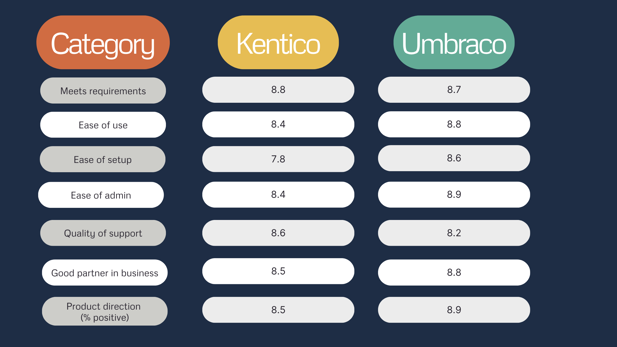
| Umbraco HQ has a clear, singular product focus: the Umbraco DXP ecosystem. Rapid release cycles, short feedback loops, and direct community input into the product roadmap mean that the platform evolves quickly and in response to real-world agency and editor needs. G2 users rate Umbraco's product direction positively at 8.9; the highest score in this comparison across all categories. | Kentico's product story has become fragmented since spinning off Kontent.ai. The resulting market confusion (two products, overlapping messaging, different target buyers) creates genuine uncertainty about where the core Xperience platform sits in Kentico's long-term priorities. Former Kentico partners have publicly cited this ambiguity as a reason for switching, with better pricing, flexibility, and features among the reasons given for moving to Umbraco. |
Verdict
Umbraco wins on clarity of direction. Backing a platform means trusting its roadmap. A focused, community-driven product with fast release cycles is a lower strategic risk than a platform navigating internal product fragmentation.
Round 03: Multi-site & Enterprise Scalability
The test most platforms quietly struggle with
| Umbraco | Kentico |
| Umbraco's multi-site architecture is natively supported and well-proven at scale. The platform handles complex content sharing, shared media libraries, and centralised editor permissions across multiple sites without requiring additional licences per property. For organisations managing multiple brands, regions, or campaign microsites, Umbraco's composable architecture means each site can share infrastructure without inheriting unnecessary complexity. | Kentico Xperience handles multi-site deployments adequately for straightforward use cases, but the platform's headless capabilities (which are increasingly important for multi-channel and multi-site architectures) come with additional cost implications. Headless channels are not included by default and attract per-channel fees, making complex multi-site or multi-channel architectures meaningfully more expensive than the base licence suggests. |
Verdict
Umbraco wins for scaling organisations. If you're managing, or planning to manage, multiple digital properties, Umbraco's native multi-site support without per-property licence escalation is a cost advantage that compounds over time.
Round 04: Marketing & Automation Features
What the unified dashboard actually delivers
| Umbraco | Kentico |
| Umbraco takes a composable approach to marketing capability. Umbraco Engage handles personalisation and behavioural analytics, while Umbraco Commerce covers e-commerce, all natively integrated without the seams you feel with bolt-on features. For teams that don't need a full marketing suite, this means no training overhead for tools that won't be used. For those that do, the add-on ecosystem is purpose-built rather than patched together. | Kentico's headline proposition is a unified workspace: CMS, marketing automation, and personalisation in one dashboard. In principle, this is genuinely appealing for marketing teams who want to reduce tool fragmentation. In practice, the breadth of the interface can create complexity for users who only need basic content editing. It’s reported that Marketing workflow, automation, and commerce capabilities also lag behind specialist competitors at larger scale, particularly for Kentico 13 integrations. |
Verdict
A draw, with a caveat. Kentico's unified workspace has real appeal if your team actively uses marketing automation. If your primary use case is content management with selective marketing add-ons, Umbraco's composable model avoids the interface complexity of a suite you're only partially using, but still maintains the capability of dynamic automation too.
Round 05: Partner Ecosystem & Agency Access
Who can actually build and support your platform
| Umbraco | Kentico |
| Umbraco operates an inclusive partner programme designed specifically for agencies of all sizes. Lower entry requirements, accessible certification, and a growing global network. The open-source community means developer knowledge is widely distributed; you're not dependent on a small pool of certified specialists. For clients, this creates genuine competition between agencies and better commercial leverage when tendering for projects. | Kentico's partner network is intentionally selective. Focused on deep, certified relationships with a smaller group of established agencies. For clients, this means working with experienced specialists, but the concentrated pool reduces competitive tension in the agency market. Critically, the community is not growing: former Kentico partners have publicly moved to Umbraco, citing platform direction and commercial terms, and Kentico's own case studies still rely heavily on Kentico 13 to evidence their ecosystem. |
Verdict
Umbraco wins on ecosystem momentum. A growing, inclusive partner network gives clients more choice, more competition, and more long-term confidence that the talent pool to support their platform will exist in three years, not just today.
Round 06 (the final round): Content Editor Experience & Onboarding
The platform your team lives in every day
| Umbraco | Kentico |
| Umbraco's back-office is purpose-built for content editors. Clean, intuitive, and deliberately stripped of tools that would distract editors. Onboarding time is consistently reported as low, and teams reach content independence quickly without sustained agency involvement. For organisations with high editorial churn out or frequent staff turnover, reduced training overhead is a real operational saving that rarely appears in platform comparison spreadsheets. | Kentico's unified workspace creates a trade-off: the same dashboard that gives marketers access to automation tools also introduces complexity for users who primarily need to publish content. Training requirements are higher than lean CMS alternatives, and the breadth of the interface can be elaborate for smaller editorial teams. The platform's own support structure acknowledges this; tiered professional support contracts are required to navigate enterprise-level complexity. |
Verdict
Umbraco wins on editor experience. G2 peer data scores Umbraco at 8.8 for ease of use against Kentico's 8.4. A smaller gap than against Sitecore, but meaningful when multiplied across an editorial team working at volume and pace.
The Peer Review Scorecard
A comparison from real users. Independent ratings.
The Winner: Umbraco (on points)
This is a closer fight than Sitecore, and that's worth saying plainly. Kentico Xperience is a capable platform with genuine strengths in marketing automation and enterprise support. But for mid-market organisations that want transparent pricing, platform momentum, native multi-site capability, and a growing pool of agencies to work with, Umbraco wins. And the gap is widening, not closing, as Kentico navigates its product fragmentation challenge.

